
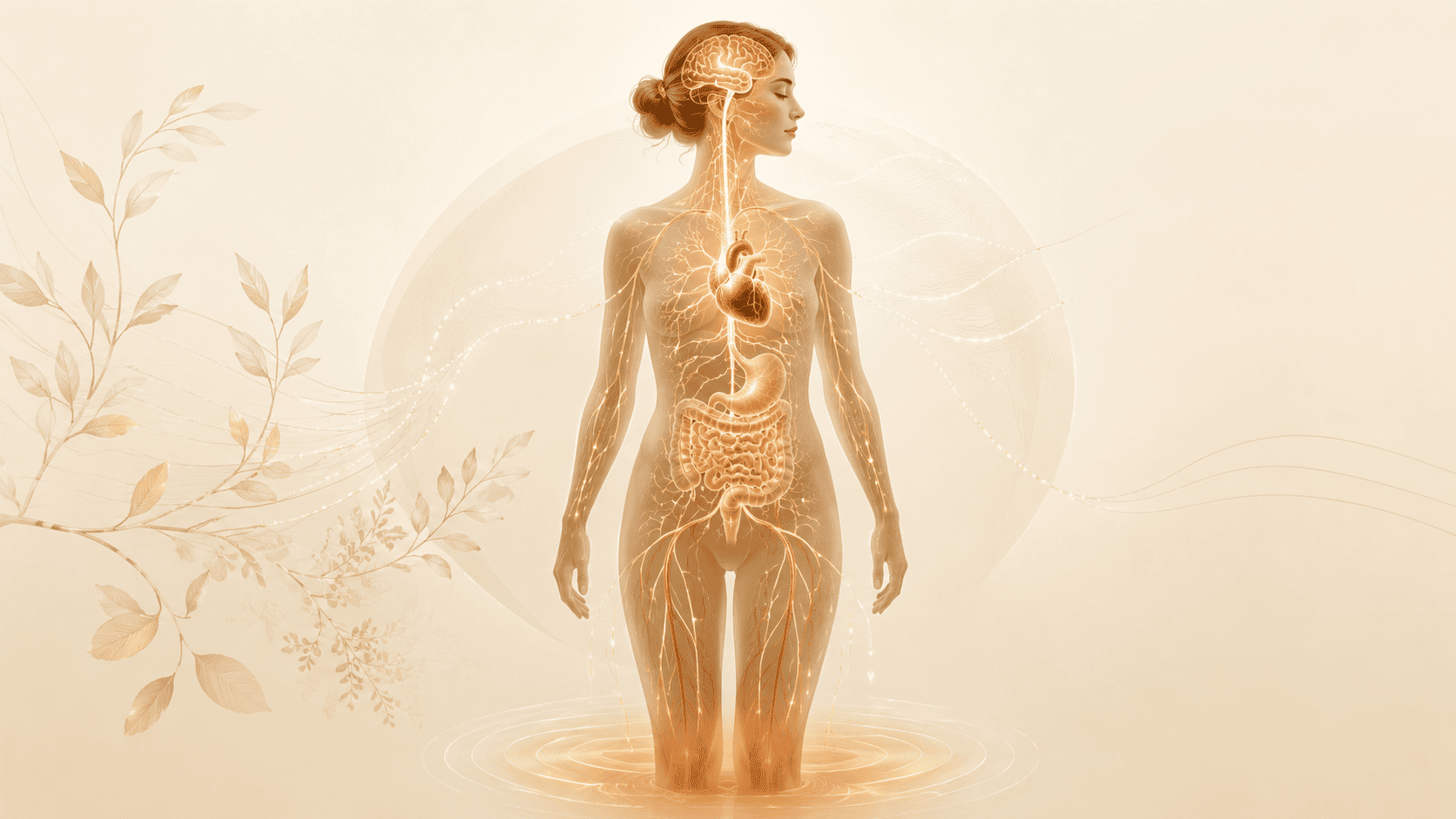
When the Nervous System Cannot Regulate
Postural Orthostatic Tachycardia Syndrome (POTS) and other forms of dysautonomia are disorders of autonomic regulation. They are not simply heart rate problems. They are nervous system stability problems.
At Helixona, we approach POTS as a systems-level condition — one that often overlaps with connective tissue instability, immune dysregulation, toxin burden, and mitochondrial strain.
POTS is rarely isolated.
The underlying issue is autonomic instability — the body’s inability to regulate blood flow, heart rate, and vascular tone efficiently. The autonomic nervous system has two primary branches: Sympathetic (fight or flight) and Parasympathetic (rest and regulate).
In POTS, this balance is disrupted.
Often initiated by viruses, mold, infections, or trauma.
The nervous system becomes highly sensitized and reactive.
Blood vessels fail to constrict appropriately; venous return drops.
Mitochondrial energy becomes insufficient to maintain regulation.
POTS manifests as a downstream result of systemic stress.
POTS may develop after viral illness (including Long COVID), mold exposure, chronic infections, trauma, concussion, hormonal shifts, significant stress, or connective tissue instability (EDS). Often, multiple factors interact.
Living with POTS can feel limiting and unpredictable. Before treatment begins, we establish your Why. Is it independence? Returning to work? Being able to stand without fear? Cognitive clarity?
| Neurological | Autonomic balance, sympathetic overdrive, vagal tone, neuroinflammatory patterns |
| Electrical | Cellular voltage effects on vascular tone, mitochondrial output, and signal regulation |
| Biochemical | Mold and toxin burden, chronic infections, viral reactivation, mitochondrial markers |
| Clinical Mapping | Onset timing (post-viral, mold, trauma), EDS patterns, MCAS symptoms, sleep, stress |
Calming the nervous system before intensity. Aggressive detox or antimicrobial therapy without stabilization can worsen orthostatic symptoms.
Once stabilized, we address the dominant driver—whether it’s post-viral inflammation, mold, mitochondrial collapse, or trauma imprinting.
Autonomic retraining is critical. We focus on vagal tone strengthening, stress response recalibration, and gradual conditioning.
Living with POTS can feel limiting and unpredictable.
Before treatment begins, we establish your Why. Is it independence? Returning to work? Being able to stand without fear? Cognitive clarity?
Your Why anchors you during stabilization and progression.
POTS may be a primary neurological instability or secondary to a deeper Lead Actor. We use our Four-Lens Evaluation to determine this:
We evaluate autonomic balance, sympathetic overdrive, vagal tone, neuroinflammatory patterns, and stress response imprinting. Autonomic instability is measurable.
Cellular voltage affects vascular tone, mitochondrial output, and signal regulation. Electrical instability can impair energy production and increase orthostatic intolerance.
We assess mold and toxin burden, chronic infections, viral reactivation, mitochondrial markers, electrolyte balance, hormonal patterns, and inflammatory markers. If mold or infection is primary, autonomic instability may improve when the burden is reduced.
We analyze onset timing (post-viral? post-mold? post-trauma?), EDS or hypermobility patterns, MCAS symptoms, sleep quality, and stress load. Patterns reveal drivers.
Many patients present with overlapping Ehlers-Danlos Syndrome, Mast Cell Activation Syndrome, and POTS. These conditions are interconnected. Connective tissue laxity affects vascular tone. Mast cell mediators influence blood vessels. Autonomic stress amplifies immune reactivity. Treating only one layer often leads to incomplete improvement. Sequencing matters.
This phase may include:
Aggressive detox or antimicrobial therapy without stabilization can worsen orthostatic symptoms. Stability first.
Once stabilized, we address the dominant driver.
If post-viral inflammation is primary → reduce inflammatory signaling.
If mold is primary → reduce toxin burden.
If mitochondrial collapse is primary → restore energy production.
If trauma imprinting is primary → recalibrate autonomic patterns.
We integrate:
Progress is layered.
Autonomic retraining is critical. This phase focuses on:
Resilience reduces flare cycles.
Common POTS management may include:
These can be helpful. But if underlying inflammatory, infectious, or toxic drivers remain, instability may persist.
Long-term improvement often requires systems-level repair.
POTS is not a single-cause condition. It can develop after viral illness (including Long COVID), mold exposure, chronic infections, significant stress or trauma, concussion, hormonal shifts, or connective tissue disorders like Ehlers-Danlos Syndrome.
In many patients, multiple stressors interact. The autonomic nervous system becomes dysregulated after prolonged inflammatory or physiological strain.
No. While POTS involves heart rate changes, it is primarily a disorder of autonomic nervous system regulation.
The heart is responding appropriately to signals from the nervous system — it is not the root malfunction. This is why cardiology workups are often normal.
Connective tissue supports blood vessels. In hypermobility disorders, blood vessels may not constrict efficiently, leading to pooling in the lower body when standing. The autonomic nervous system compensates by increasing heart rate.
Over time, this compensation can become chronic. Structural instability and autonomic regulation are closely connected.
Mast cell mediators influence blood vessel dilation and inflammatory signaling. If mast cells are unstable, vascular tone can fluctuate.
Additionally, chronic autonomic stress may increase immune reactivity. This is why the POTS–MCAS–EDS triad is frequently observed.
Post-viral POTS is increasingly recognized. Viral infections can trigger immune dysregulation, disrupt autonomic signaling, increase inflammatory mediators, and impair mitochondrial function.
In some patients, the nervous system does not fully recalibrate after the infection resolves.
Standing requires coordinated vascular constriction and autonomic balance. If the autonomic nervous system is unstable, blood may pool and heart rate may spike.
Heat exposure (like hot showers) causes vasodilation, which can worsen pooling and symptoms.
Not necessarily. Fatigue may involve autonomic overdrive, mitochondrial inefficiency, chronic inflammation, poor sleep quality, or hormonal dysregulation.
Deconditioning can contribute, but it is often secondary to systemic strain.
Exercise can be helpful — but timing and structure matter.
If performed during severe instability, aggressive exercise may worsen symptoms. Gradual, strategic progression after stabilization is often more effective.
Medications may regulate heart rate or blood pressure. However, if underlying drivers — such as mold exposure, chronic infection, mitochondrial dysfunction, or immune instability — remain, autonomic dysregulation may persist.
Lasting improvement often requires addressing systemic contributors.
Yes. Especially when inflammatory burden is reduced, nervous system regulation improves, mitochondrial function is supported, sleep is restored, and stress patterns are recalibrated.
Improvement is typically gradual and layered.
The first step is identification. Determine: Is this post-viral? Is mold contributing? Is connective tissue instability a factor? Is mast cell dysregulation present? Is mitochondrial support needed?
Once the dominant driver is identified, treatment can be sequenced safely.
You may benefit from structured evaluation if:
Autonomic dysfunction rarely exists in isolation.